Fixed or Mobile CCTV: Which System Suits a Changing Risk Profile?
Choosing between fixed CCTV and redeployable cameras is no longer a purely technical decision.
The real question is whether the risk remains in the same place throughout an operation, or whether it changes over time.
Across construction sites, public spaces, housing estates, car parks and wider infrastructure, risk rarely stays static. Access points move, assets are relocated, site layouts evolve and new blind spots can emerge as conditions change. In these environments, the comparison between fixed and mobile CCTV has a direct impact on surveillance coverage, response capability and long-term value.
The answer depends on how risk behaves over time. Fixed CCTV systems and mobile surveillance solutions both play a role, but their suitability is determined by how well they align with changing security needs and operational conditions.
What does a changing risk profile actually mean?
A changing risk profile does not simply refer to an increase in crime or unsafe conditions. It refers to situations where the location, nature or intensity of risk shifts throughout the lifecycle of a site or operation.
This is common across construction projects, phased developments and public environments. High-risk areas can move as works progress, access routes are altered or activity concentrates in different parts of a site. In public spaces, local authorities may respond to evolving crime hotspots, antisocial behaviour or patterns of nuisance activity that change location over time.
In these scenarios, surveillance systems must adapt to the site, rather than the site being constrained by fixed camera positions. The effectiveness of CCTV depends heavily on coverage being aligned with actual conditions. Cameras positioned correctly will support monitoring and deterrence. Cameras left in outdated positions will not.
This is why the decision between fixed and mobile CCTV should be based on how risk moves, not just on the type of system being installed.
Where fixed CCTV works well
Fixed CCTV systems remain an essential part of many security strategies. Where environments are stable and key risk points are well defined, fixed cameras provide consistent and reliable monitoring.
Entrances, building perimeters, loading areas, reception points and established high-traffic areas are typical locations where fixed CCTV cameras perform well. In these settings, viewing angles remain relevant over time and continuous monitoring is required. Fixed systems also integrate effectively where infrastructure already exists. Power supply, network connectivity and mounting points are often already in place, making installation more straightforward for long-term coverage.
However, fixed CCTV has clear limitations in environments where the site layout changes. Once installed, cameras remain in position. Adjusting coverage, addressing blind spots or monitoring new areas typically requires additional installation work. They are also highly costly, due to the extent of video equipment and cabling required. Where risk moves faster than infrastructure, fixed systems can become less effective over time.
Where redeployable cameras outperform
Redeployable cameras and mobile CCTV solutions are designed for environments where surveillance coverage needs to adapt. These systems are particularly suited to construction sites, evolving public spaces, infrastructure projects, vacant properties and locations where risk does not remain fixed. Instead of committing to permanent infrastructure, cameras can be deployed where they are needed and repositioned as conditions change.
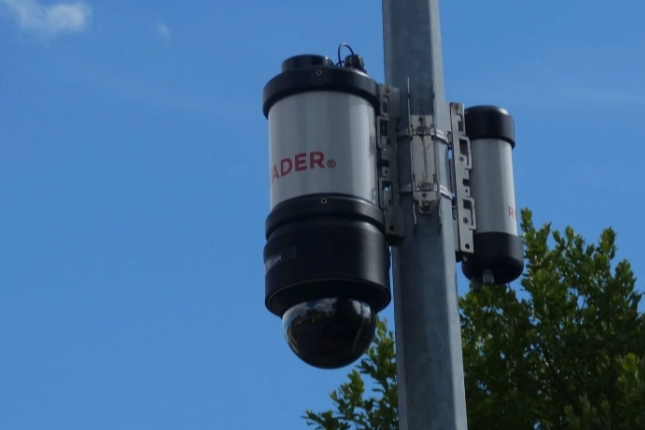
REVADER’s redeployable CCTV systems are self-contained units designed for rapid deployment and ongoing repositioning. Cameras can be installed on suitable structures or deployed via CCTV towers, with options for mains, battery or solar power depending on site conditions. This approach allows surveillance to follow the risk. As security priorities change, cameras can be relocated to new access points, vulnerable areas or emerging hotspots without requiring new infrastructure each time.
Rather than replacing fixed CCTV, redeployable systems extend coverage into areas where fixed cameras cannot easily adapt.
The differences that really matter
Understanding the key differences between fixed CCTV systems and redeployable cameras helps inform a more effective security strategy.
Installation
Fixed CCTV cameras require installation planning, infrastructure and permanent mounting. This can involve cabling, network setup and defined mounting positions.
Redeployable cameras are designed for faster deployment. Units can be installed with minimal infrastructure and brought into operation more quickly, which is particularly useful where security needs arise at short notice.
Mobility
Fixed cameras provide consistent coverage of a defined area but cannot be easily moved.
Redeployable cameras can be repositioned as site conditions change. This allows surveillance coverage to remain aligned with evolving risks rather than remaining fixed in one location.
Infrastructure
Fixed CCTV systems rely on established infrastructure including power and network connectivity.
Mobile CCTV systems are designed to operate with greater independence. With flexible power options including solar power, they can be deployed in locations where permanent infrastructure is not available or not practical.
Visibility and Coverage
Fixed cameras are effective for monitoring specific points such as entrances or building perimeters.
Mobile CCTV towers and redeployable units can provide wider area visibility, particularly in large or changing environments. This helps reduce blind spots and improve overall surveillance coverage.
Operational Flexibility
The effectiveness of CCTV systems depends on positioning, monitoring and suitability for the environment. Fixed systems offer stability. Mobile systems offer adaptability.
In environments where conditions change, flexibility becomes a key operational advantage.
Maintenance and durability
Both fixed CCTV systems and mobile surveillance units must deliver reliable performance across demanding environments.
Fixed systems are permanently installed and typically operate continuously. Maintenance often requires site access and may involve specialist equipment or technicians, particularly in exposed or high-level locations.
Redeployable CCTV systems can be inspected between deployments and checked before being moved to new locations. This allows operators to review performance, power and storage before redeployment while maintaining continuous monitoring.
In both cases, reliability depends on appropriate setup, regular checks and ensuring that systems remain suited to the current site conditions.
How to choose the right system for your site
Selecting the right CCTV solution requires an understanding of how the site operates and how risk is likely to change. Key considerations include:
Whether risk is permanent or likely to move
How frequently the site layout will change
Whether sufficient infrastructure exists for fixed installation
Whether flexibility is required to reposition cameras
If surveillance needs are stable and predictable, fixed CCTV systems may be appropriate. If security priorities are likely to change, or if an operator is looking to maximise value for money, redeployable cameras offer greater flexibility.
Where both conditions exist, combining fixed and mobile systems allows for a balanced approach.
Summary
The choice between fixed CCTV and redeployable cameras depends on how risk behaves within a site or operation. Fixed systems provide consistent monitoring where conditions are stable. Mobile CCTV and redeployable solutions provide flexibility where risk changes. For some environments, an effective approach is to combine both, using fixed cameras for permanent coverage and redeployable systems to respond to evolving threats.
Why REVADER?
REVADER designs and manufactures redeployable CCTV systems for environments where conditions change and fixed infrastructure alone is not sufficient.
Our redeployable cameras and CCTV towers are designed for rapid deployment and can be repositioned as site conditions evolve. Systems can operate independently or integrate with existing CCTV systems and control rooms, allowing organisations to extend coverage without replacing existing infrastructure.
With flexible power options and a focus on real-world performance, REVADER supports construction sites, public sector organisations and infrastructure projects where surveillance needs to adapt over time.
Find out how we can help with your CCTV requirements.
Frequently Asked Questions
-
Fixed CCTV systems are suited to stable environments where risk remains in the same location. However, where conditions change, redeployable cameras may provide better coverage over time.
-
Redeployable CCTV systems are designed to operate in locations where infrastructure is limited, using flexible power options and wireless connectivity. Construction sites are ideally suited.
-
In many cases, they can be used alongside one another. Combining fixed and mobile CCTV allows organisations to maintain permanent coverage while adapting to changing risks across a site.
-
Redeployable CCTV systems are designed for rapid deployment and can be installed more quickly than traditional fixed systems, depending on site conditions. Often cameras can be installed in a matter of minutes.
-
The key difference is flexibility. Redeployable cameras can be repositioned as conditions change, allowing surveillance coverage to adapt over time rather than remaining fixed.
